
The other morning I woke early. The summer sun was piercing through the blinds and wouldn’t be blocked by an eye pillow. It was going to be a hot, still day. The kind good for nothing much, and with not much to do I decided on a meander. After dressing and stepping out into the morning swelter, I found myself not under the air-con at my local coffee place but instead boarding a Thameslink train into town, bound for I wasn’t sure where. Partway in, I remembered the Silk Road Bazaar was on at the Canopy Market near St Pancras, and I made my way there amongst what felt like all of London and a couple of other cities’ worth of people, everyone looking for cold, brunchtime booze and ice creams. I wasn’t.
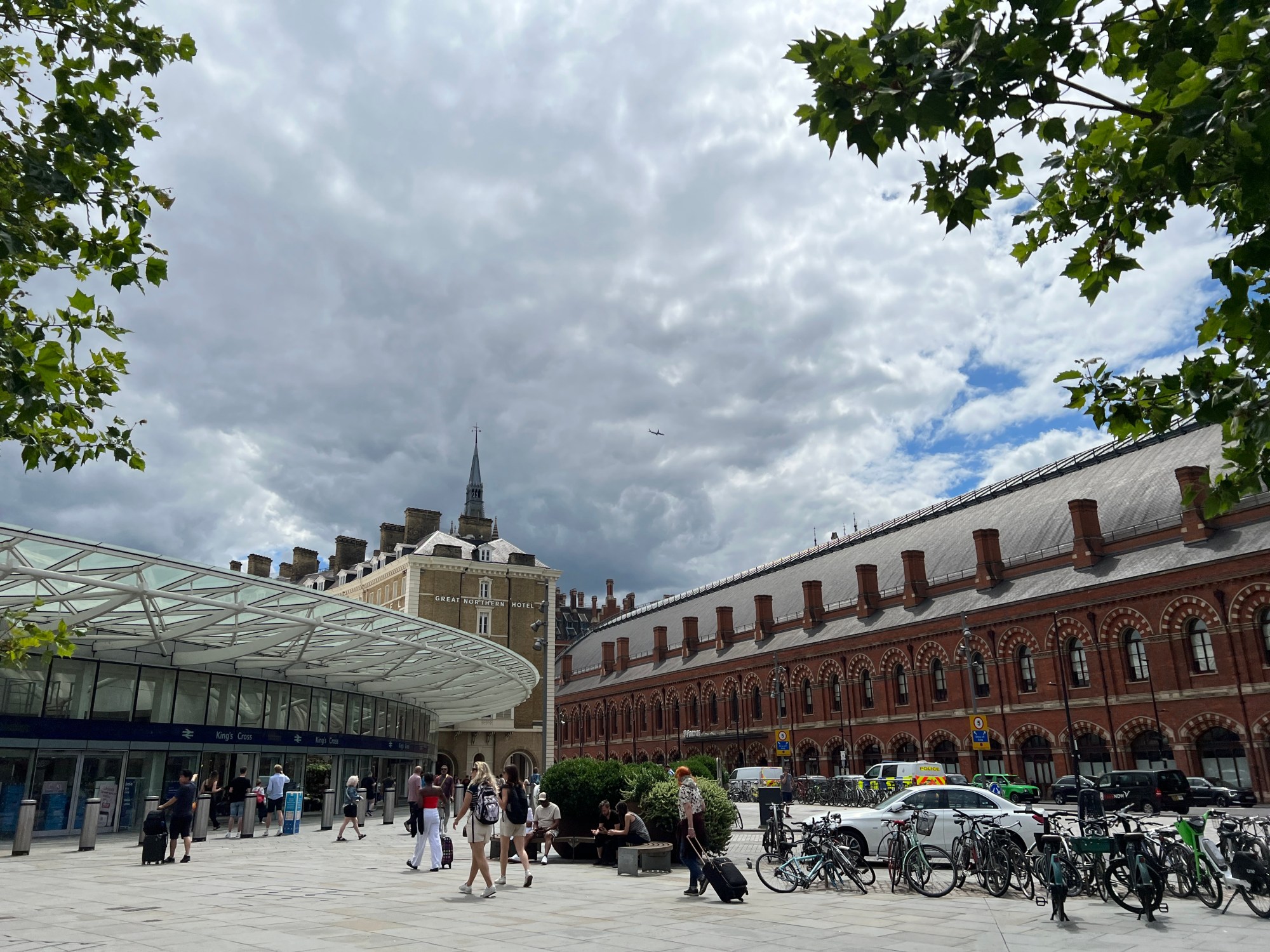
I wanted it to be good, but the market was a disappointment, as they always tend to be and I felt restless and sweaty, neither ready to return home nor desiring to spend any additional time among the throngs at Coal Drops Yard. It was nearing lunch but the heat had taken my appetite. I went back down into King’s Cross station, where I bought a berry smoothie and set out to let myself get lost in the heat. There was something a little out of reach churning in my brain that needed to be walked off.
It was a day for flânerie, which is a 19th-century French literary concept for ‘strolling about aimlessly’. I was first introduced to it in a European cinema class I took as an elective for my Master’s degree. We were assigned to watch the New Wave film, Cléo from 5 to 7, a stunning work of existentialism in black-and-white that was written and directed by the great Agnès Varda. It follows a day in the life of a young singer who walks aimlessly around Paris for several hours while awaiting a life-or-death medical prognosis. She does a lot of nothing: stops into a tarot reader to have her fortune told, buys a black fur hat, sits in a cafe full of mirrors, goes to a concert rehearsal, and gradually becomes more convinced she is terminally ill and then more aware of her own power. The atmosphere of the film is one of drift and uncertainty, and it left an impression on me that has never lifted.
I even wrote an essay on it for the class in which I responded to the prompt, ‘In European cinema women are seen as passive onlookers rather than critical agents’ and compared three films with strong female leads: Cléo, as well as the German film Run Lola Run and Volver by the incredible Spanish director Pedro Almodóvar, who is well-known for writing headstrong, complex women. Volver might be his best movie. Maybe.

I argued that Cléo does not start out as a flâneuse, but transforms into one through her wanderings. I wrote that it was her constant migration from place to place and her interactions with each locale that allowed her to question and reinvent herself. As her movement guides her process of self-investigation, Cléo’s strength arrives.
My essay concluded that women can be and have been portrayed as strong, capable characters in European film and that the heroines of these three films were all developed through extensive use of physical action. The professor gave me an A and called me a feminist. At the time, I didn’t know I was. Have shed a lot of internalised misogyny since then. Am definitely a feminist.
So, yes, some days must be walked off, and this was one of those days. I set out from the station with my smoothie and walked up the busy corner and around onto Grey’s Inn Road, past Scala, where years ago I went to see the band Allo Darlin’ play and felt the rumblings of my life turning inside out.
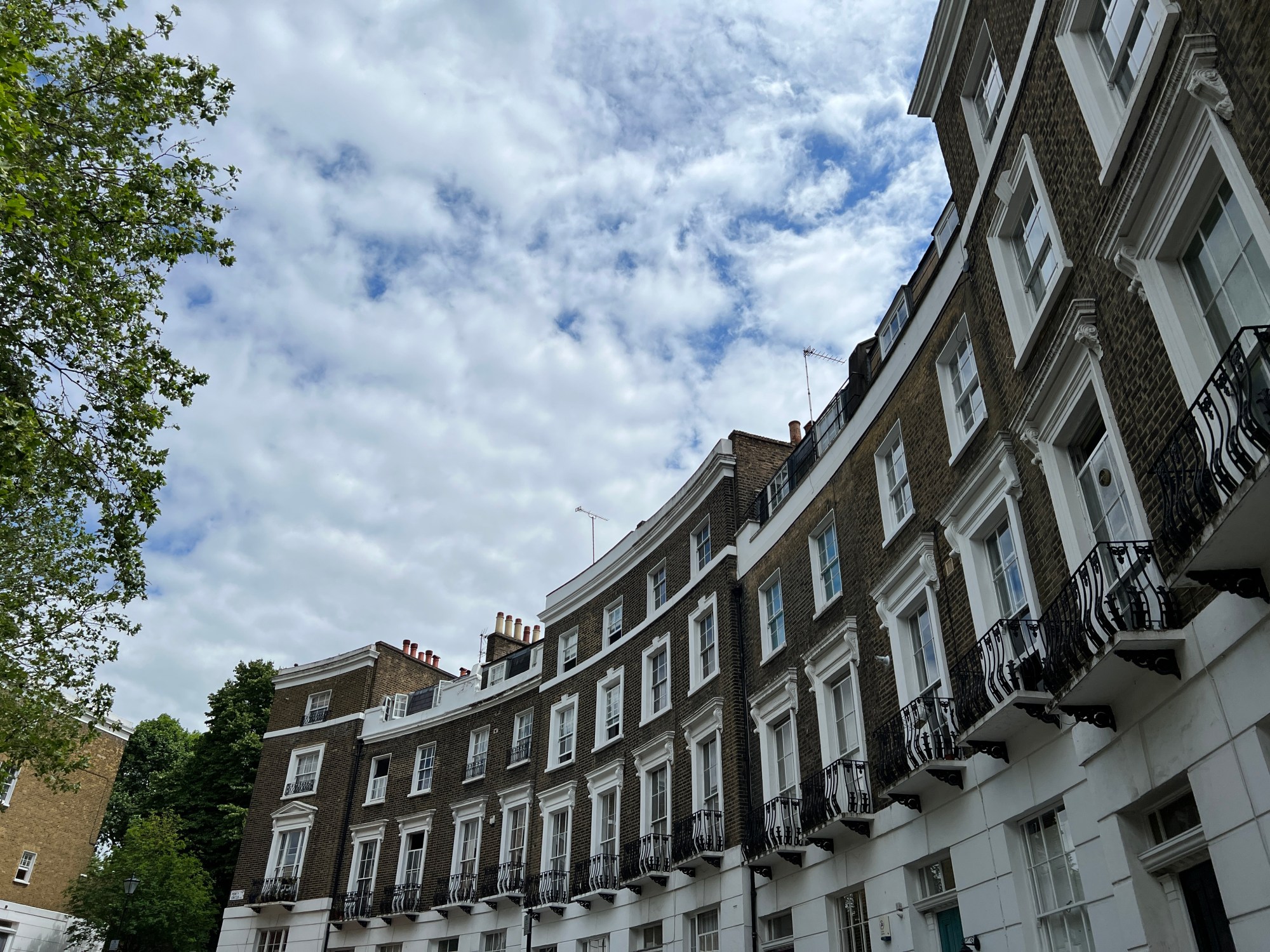
I’d vowed to myself not to look at the map and just go by what was in my brain, although I didn’t know the streets around there very well, and that was of course the point. I put on an album that was new and hoped to feel new things with it. I passed the Water Rats, a grotty pub and another place I’d been to a gig to see a friend’s band play in the sweltering, sticky back room on a bill with about six other bands in one afternoon. I didn’t go in, but turned left and walked uphill to Percy Circus – a perfectly round park surrounded by a circular avenue and curving Georgian townhouses. Prideaux Place carried me off on a short tangent that felt like another world and another time of ivy gardens and gaslamps, and maybe it was.
I started to sweat and kept looking at my Fitbit to check my heart rate wasn’t spiking, which it wasn’t and every time I looked down it was at 111. The streets got muddled around there, but there were no people anywhere and it felt like the pandemic times. Somehow turning back and forth I ended up at Myddleton Square Gardens, where the towers of St Marks Church rose like heat undulating spectres over the trees, and there were people laying out blankets on the grass to have a picnic and disregarding signs that said no alcohol in the churchyard. I didn’t stop and go in. There was more walking to do.
At this point, I’d come up with a goal of finding Farringdon Station without the map, which would get me to the Elizabeth Line and an air-conditioned seat home. I knew vaguely where I was and if I kept a general direction southeast I would probably find Farringdon eventually. The sun wasn’t much help – it stayed hot overhead and lacked any directional suggestions. But there was more music – a playlist filled with all the songs so far this year – Hatchie, the New York Dolls, The Verlaines and Barrie. Suede made a brief appearance to teleport me to 2016. I never listen to music in the right year.
Eventually I popped out onto St John Street, a name I knew well but didn’t know it this far north, indeed didn’t know it even ran this far north and so wondered if it was even the same St John Street. Sure it must be but you never know in London and I was time-travelling through the heat and apocalyptic emptiness. There was no choice but to follow it and find out.
This brought me down past the hulking towers that make up the City University campus, which I’d never seen before, and to a strange green corner at Percival Street where three mature oak trees must have stood far longer than any of the Brutalist monoliths around there.
Eventually, I arrived before Smithfield Market at St John Bread and Wine and tipped my hat to Anthony Bourdain, who loved that restaurant. Farringdon Station was just there, with its cool, comfy trains, but was I ready to end it here? I was hot and still restless even after two miles, and no closer to exorcising the conversations with the voice in my mind so there was no choice but to keep going.

I knew my next and probably final stop was to be Liverpool Street, the next station where I could pick up the Lizzie Line. First, it was through the wildly painted wrought-iron traces of Smithfield Market, which never stops smelling of fish and rotting meat even when closed like it was then, and much worse in the midday sun. All lined up inside the market were six red phone boxes, all dead and wishing for tourists. I wanted to veer off down the medieval street called Cloth Fair, but there was a sandwich board pronouncing that St Bartholomew the Great was open: London’s oldest parish church, founded 1123.
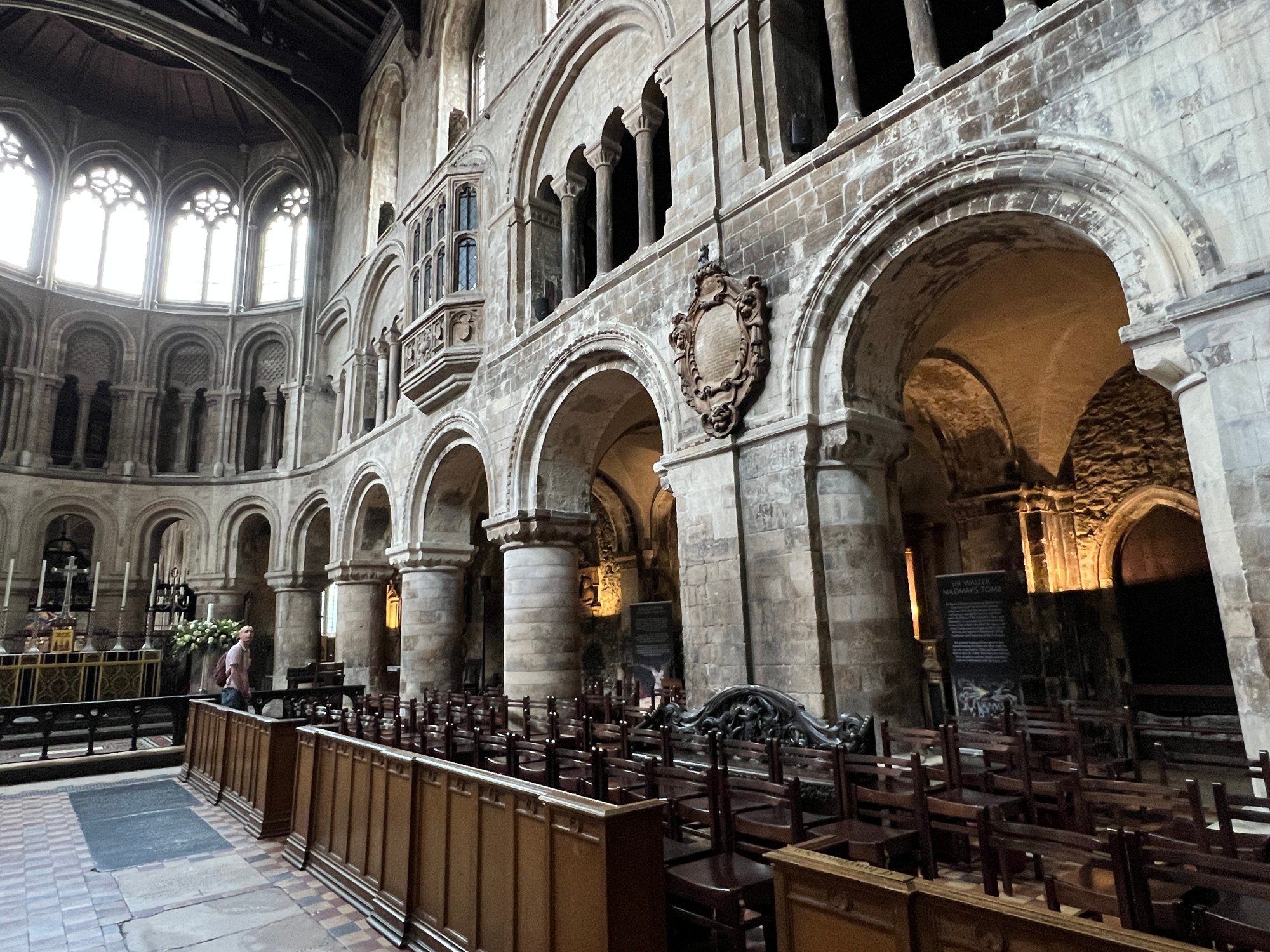
Why hadn’t I ever been in here before, and why had I never seen it open? A strange day where no one was about and here was an open church. In I went trying not to interrupt the conversations of a group of deaf visitors to see a golden sculpture of a man’s form with all his muscles exposed, next to which a sign told me it was a work of art called “Exquisite Pain” by the great Damien Hirst. It was painful to look at, and the exposed muscles and tendons made me think of my own which were starting to ache a little from heat and movement.
St Bartholomew has other wonders including some of its original medieval wall and floor tiles tucked in a corner, as well as the Lady Chapel at the back where Benjamin Franklin studied and wrote. I didn’t know that.

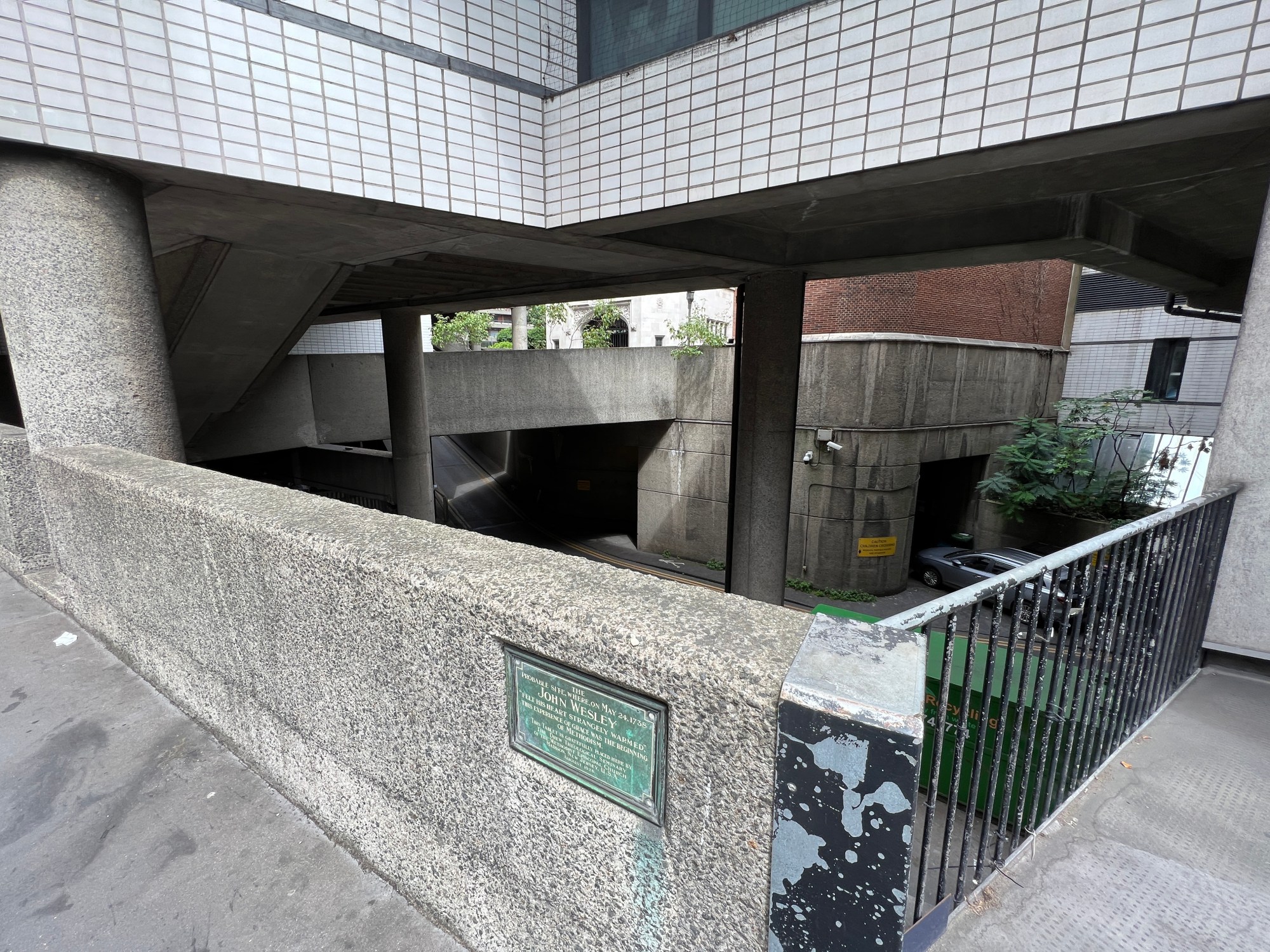
After the cool rest of St Bartholomew, the air outside was truly stifling and my body had had it, but couldn’t bring myself to turn back for Farringdon and so carried on up alongside the behemoth Barbican, past a strange corner next to a parking garage entrance where a green sign marked the ‘probable spot’ where John Wesley ‘felt his heart strangely warmed’ and today it seems like a truly improbable place for the start of Methodism.
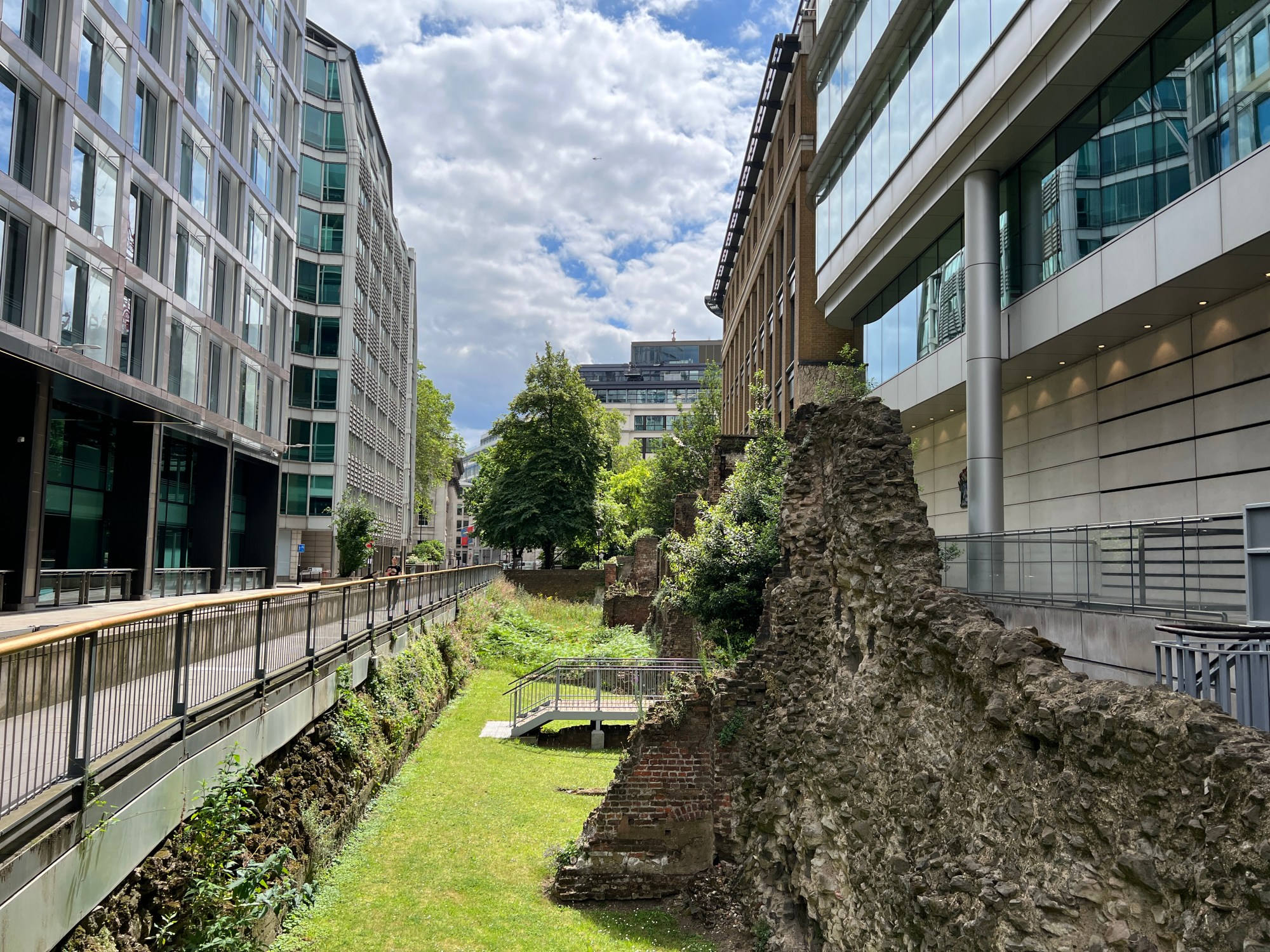
By now I was at London Wall and stopped for a moment to admire the remains of the old wall which are so unlikely and hidden away under glass towers and it seems preposterous that once this was the great barrier that marked where London was and everything else wasn’t.
The last mile was hot and tough. Moorgate is ugly and busy, and I skirted up through Finsbury Circus which smelt of piss and had clearly been used as a public toilet for people who’d wished they’d gotten tickets to Glasto but instead ended up day drinking into a sunburn at a Greene King chain pub outside Liverpool Street station.
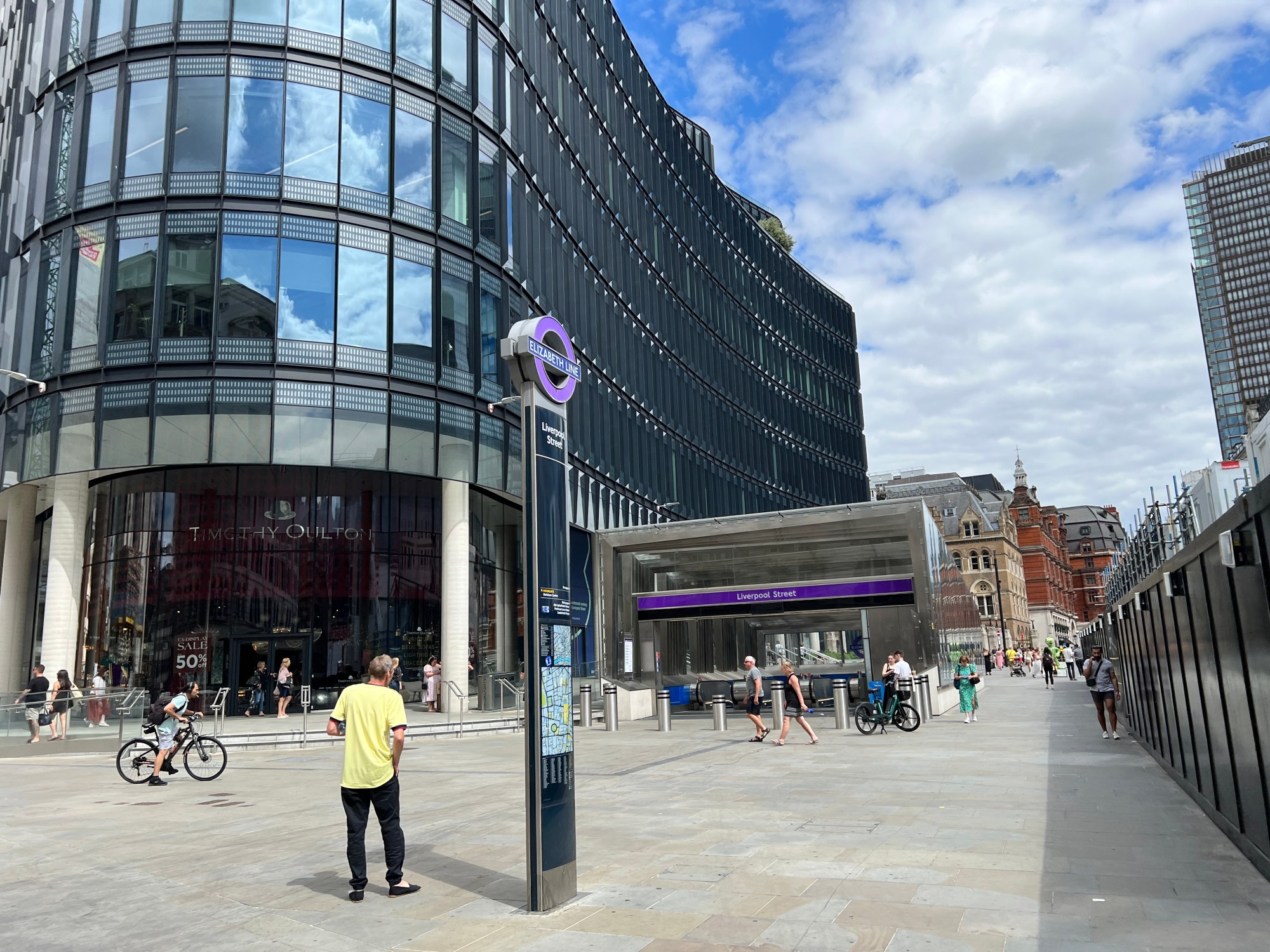
And here I popped out perfectly at the station parade, where the purple marquee announced the brand-new entrance into the Elizabeth Line. I didn’t stop and think about what I’d done or if it meant anything. Some days just need to be walked off.
I took the escalator down anticipating the cool air on my damp brow and kept an eye on my heart rate. It was at 111 again.

 Megan Eaves-Egenes
Leave a comment